




AI Nudes Are Targeting Kids Who Never Sent One: How to Face This Dangerous New Threat

For years, parents have warned their kids to never send nudes. And kids still need that rule.
But it needs an update. Because AI nudes and deepfakes have changed the conversation.
The proliferation of AI nudifying apps has created a second, critical part of the conversation that many families aren’t having: What to do when someone takes an ordinary picture of your child and makes it sexually explicit with AI.
Real cases: How everyday teens and kids become victims of AI Nudes
You might be thinking, “Wait! That only happens to celebrities like Taylor Swift.”
If you think this couldn't happen to your child, the reality is that AI nudes are hitting middle and high schools everywhere. Check out these cases:
Texas teen Elliston Berry
Fourteen-year-old Elliston Berry woke up to frantic texts from a friend. Nude images of her and two friends were circulating.
But Elliston had never taken a nude.
Someone had taken an ordinary photo from her Instagram and used AI to make her and two friends appear nude. By the end of the day, fake nude images of nine girls at her Texas high school were circulating.
Fueled by this crisis, she played a pivotal role in getting the TAKE IT DOWN Act passed into federal law, which officially forces online platforms to scrub explicit fakes within 48 hours or face massive federal fines.
Dozens of victims at a Pennsylvania private school
Two classmates took ordinary photos, from social media, yearbooks, and FaceTime chats, to create roughly 350 fake nude images using AI. The boys were sentenced to probation.
Utah AI tech executive turns yearbook photos into AI porn
Burke Clark Powers, an AI tech company executive faces charges for allegedly using AI to generate sexual images. According to court documents, his ex-wife discovered the images on a Google drive she shared with the FBI. She said he scanned yearbook photos into the program he was using. She discovered AI-generated explicit images of a minor relative, as well as other minors.
These are just a few examples.
[[CTA]]
Why Staying Off Social Media Won’t Protect Your Child from AI
It’s easy to think the solution is just deleting your teen's social media accounts, but a digital timeout won't protect them from AI deepfakes.
Anyone can take a photo of someone else in public, pull an image from a yearbook, or save a picture posted by someone else and then use an AI tool to create a fake nude.
Just look at Meta’s AI glasses! They’ve been dubbed “pervert glasses” because they can make it easier to discreetly capture photos or video of people in public. Those images can then be fed into separate AI nudification tools.
Related: Deep Trouble With Deepfake Porn: 9 Best Tips to Safeguard Your Kids
The numbers behind the crisis
To understand just how massive this problem has become, take a look at these eye-opening statistics:
- 700 million visits: "Nudification" apps have been accessed more than 700 million times worldwide, generating $117 million in revenue, according to the BBC.
- 1.2 million children impacted: A UNICEF study across 11 countries revealed that at least 1.2 million children disclosed having their images manipulated into explicit deepfakes in just one year.
- 55% of Teens Have Tried It: In a recent study published by the NIH, 55% of 557 U.S. teens admitted to using a "nudification" tool to create at least one image.
- 100+ Apps on mainstream app stores: A Tech Transparency Project (a non-profit watchdog) investigation found over 100 AI-powered nudifying apps actively available for download on the Google Play Store and Apple App Store.
There is no longer a realistic way for a child to keep every image of themselves out of someone else’s hands.
That means kids need more than the rule, “Don’t send nudes.” They must be taught what to do if someone makes one of them.
Related: AI Safety for Kids: 6 Best Practices Every Parent Should Know
How to talk to your child about AI deepfakes: A parent script
When it comes to AI deepfakes, warning our kids "don't send nudes" isn't enough anymore—we have to give them a real, actionable game plan. Using a simple conversation script can help prepare your child so they know exactly what to do and who to tell if they are targeted.
Here’s a script you can use:
Parent: “I want to practice something with you. What would you do if someone at school used AI to make a fake nude of you?”
Child: “I don’t know.”
Parent: “First, don’t panic. And don’t try to handle it alone. Don’t argue with the person, pay them, send them anything, or make one back.
“Next, save any useful information that you see—like a username, messages, threats, links, and where it was posted. But DON’T forward the image around to prove what happened.
“Then come tell me, or another trusted adult, right away. You can say, ‘Someone made a fake sexual picture of me with AI. I need your help.’
“And I want you to know something very important: If this ever happens, you are not going to be in trouble for telling me.”
Then ask:
Parent: “Who are three adults you could tell if I wasn’t available?”
Help your child identify three safe adults they can tell.
Then finish with:
Parent: “Good. So what are the steps?”
Let your child say it back to you in their own words.
How to report explicit AI deepfakes and stop the spread
Once your child has told you someone made a fake AI image of them, you need to step in immediately to report the deepfake and stop it from spreading. By acting fast with online platforms, federal tools, and school officials, you can take control of the situation and protect your child.
Here are some steps to take:
- Report the image to the platform. Under the new federal TAKE IT DOWN Act, major platforms must provide a process for reporting non-censual intimate images, including AI-generated deepfake nudes, and remove them within 48 hours of a request. If they fail to remove the image, parents can report the platform to the Federal Trade Commission.
- Report it to NCMEC (National Center for Missing and Exploited Children). Parents can report it at CyberTipline.org, or call their 24-hour hotline at 1-800-THE-LOST to make a report. Those reports are then made available to the appropriate law enforcement agency.
- Use NCMEC’s Take It Down tool to stop the image from spreading. Separate from the law, NCMEC operates a free, anonymous web tool called Take It Down. This service creates a digital marker (called a hash), of the image directly from the device. Participating platforms use that hash to detect and remove remaining copies without the image itself being uploaded to NCMEC.
One important warning: NCMEC states that if your child doesn’t already have the image on their device, don’t download it or ask someone to forward it to them in order to use TAKE IT DOWN. Instead, contact NCMEC for guidance. - Contact the school if classmates are involved. Bring the information your child already has and ask what the school will do to stop the image or video from circulating, address the students involved, and protect your child from harassment or retaliation.
- Contact law enforcement. This is especially important if someone is threatening your child, demanding more money or images, repeatedly distributing the images, or otherwise targeting them.
If the fake nude is being used for sextortion:
This is where the usual sextortion advice still applies:
Do not pay. Do not negotiate. Do not send another image. Do not continue communicating with the blackmailer.
Preserve the evidence, report the account, and report the incident to the appropriate authorities.
A fake nude can give a blackmailer the same leverage as a real one. Threat intelligence analyst Paul Raffile shared excellent, detailed steps for what to do in Sextortion Scams and Teen Suicide: One Father's Urgent Warning.
Related: Police Officer Reveals 4 Legal Dangers When Minors Share Nudes
Give kids a plan before they need it
While AI technology may be new, the parenting principle isn’t:
Kids need more than warnings. They need an actual plan. And they need to know they can come to you.
That’s the exact philosophy behind our book, Good Pictures Bad Pictures. It flips the script from a scary lecture to a simple, comfortable strategy.
Also, one of the five rules in Good Pictures Bad Pictures Jr. is to never sharing pictures of yourself without clothing on.
For AI nudes, the message can be just as simple: Tell me.

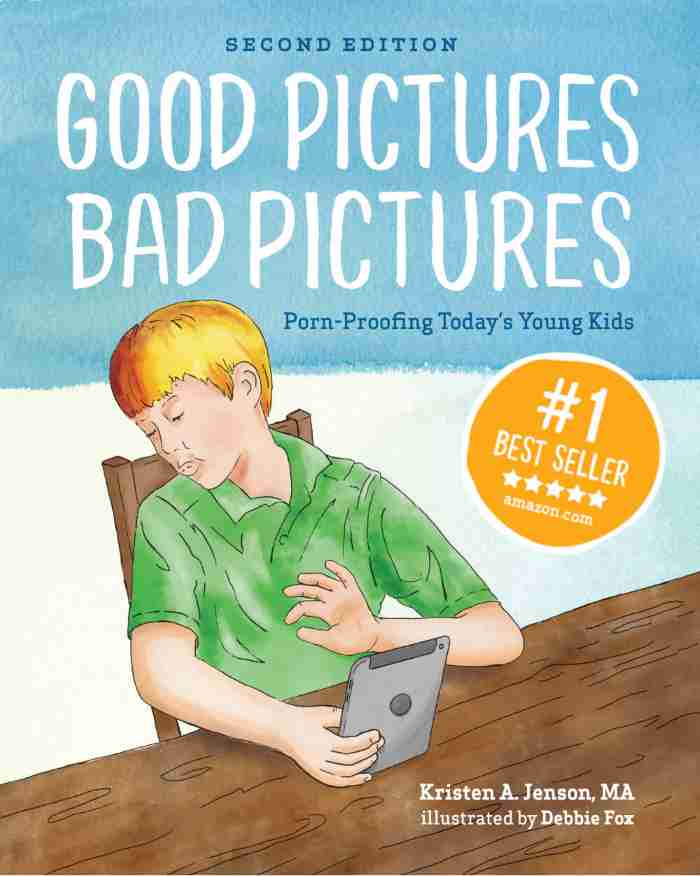
Good Pictures Bad Pictures
"I really like the no-shame approach the author takes. It's so much more than just 'don't watch or look at porn.' It gave my children a real understanding about the brain and its natural response to pornography, how it can affect you if you look at it, and how to be prepared when you do come across it (since, let's face it... it's gonna happen at some point)." -Amazon Review by D.O.
